Auto Power Off (APO1)
An automatic power cutoff circuit for 12V systems that prevents battery overdischarge in mobile and solar applications.
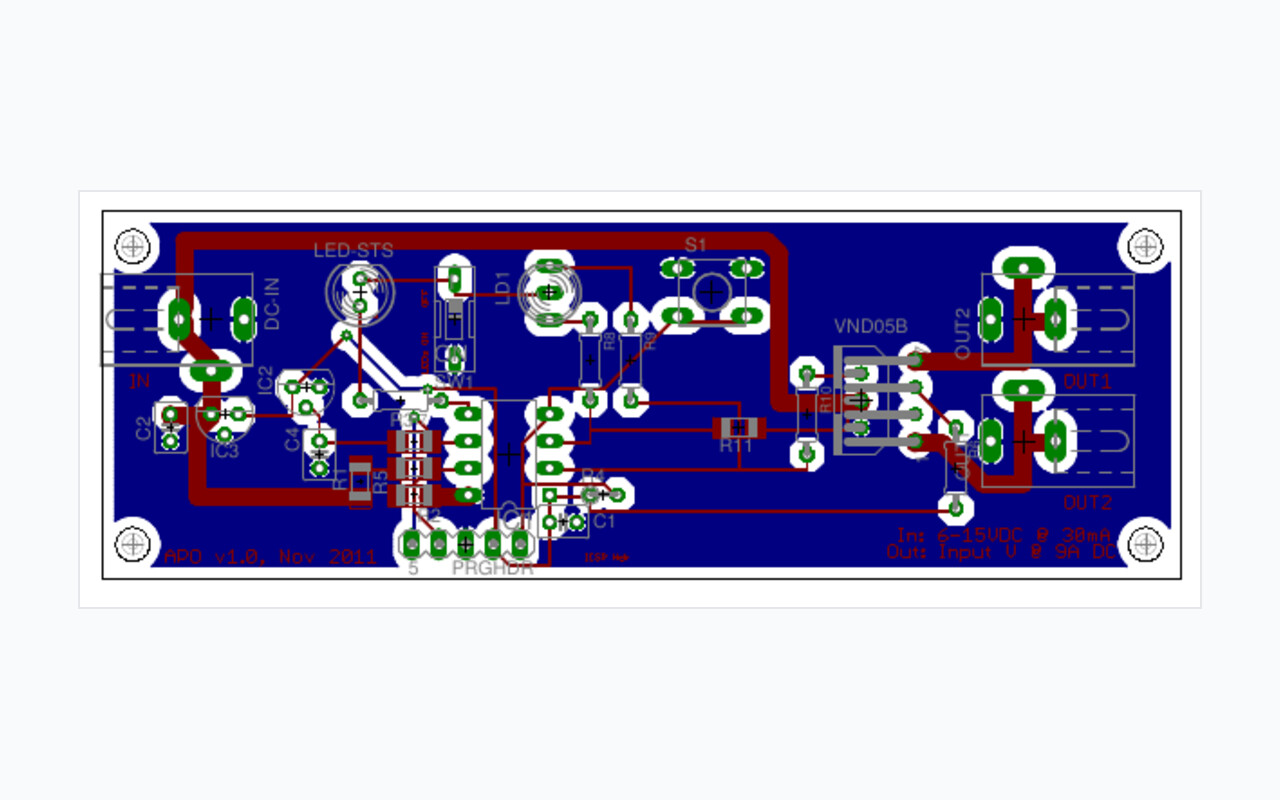
APO1 cuts power to 12V equipment when the vehicle battery falls below 12.5VDC. It exists because a radio left running in a parked car will happily flatten a battery, and a deeply discharged lead-acid battery never fully recovers.
It is also the project I took furthest on my own: component selection, schematic, simulation, board layout, fabrication, and testing.
Behaviour
The cutoff is not immediate. Once the battery drops below the threshold, a configurable delay runs before the outputs shut off. That avoids rapid cycling when the voltage hovers near 12.5V, and it has the pleasant side effect of leaving equipment powered for a while after the engine stops.
A PIC microcontroller handles the timing and user feedback, which keeps the quiescent draw low. A button gives manual on/off control, plus a forced-on mode that disables the automatic shutoff entirely. A precision voltage reference and comparator set the trip point: too high and you lose power you could have used, too low and you damage the battery you were trying to protect.
Specifications
- Two 9 amp peak outputs (with heatsink)
- 3 amps sustained without heatsink
- First output turns off after 1 minute of low voltage
- Second output turns off after 20 minutes of low voltage
Two outputs with different delays let you rank your equipment. An APRS tracker you want running as long as possible goes on Output 2; anything you can live without goes on Output 1 and dies first.
The build
I simulated the detection circuit in SPICE to verify its behaviour before committing to a layout. Ten prototype boards came back at about $17 each, and I tested every one to confirm the trip voltage.
Three of them are still in service, one in each vehicle carrying radio gear. My APRS station keeps reporting position for hours after I park, then shuts itself down before it becomes a problem.
See also
- Amateur Radio hobby page — the APRS setup this powers
- Electronics hobby page — more hardware projects